
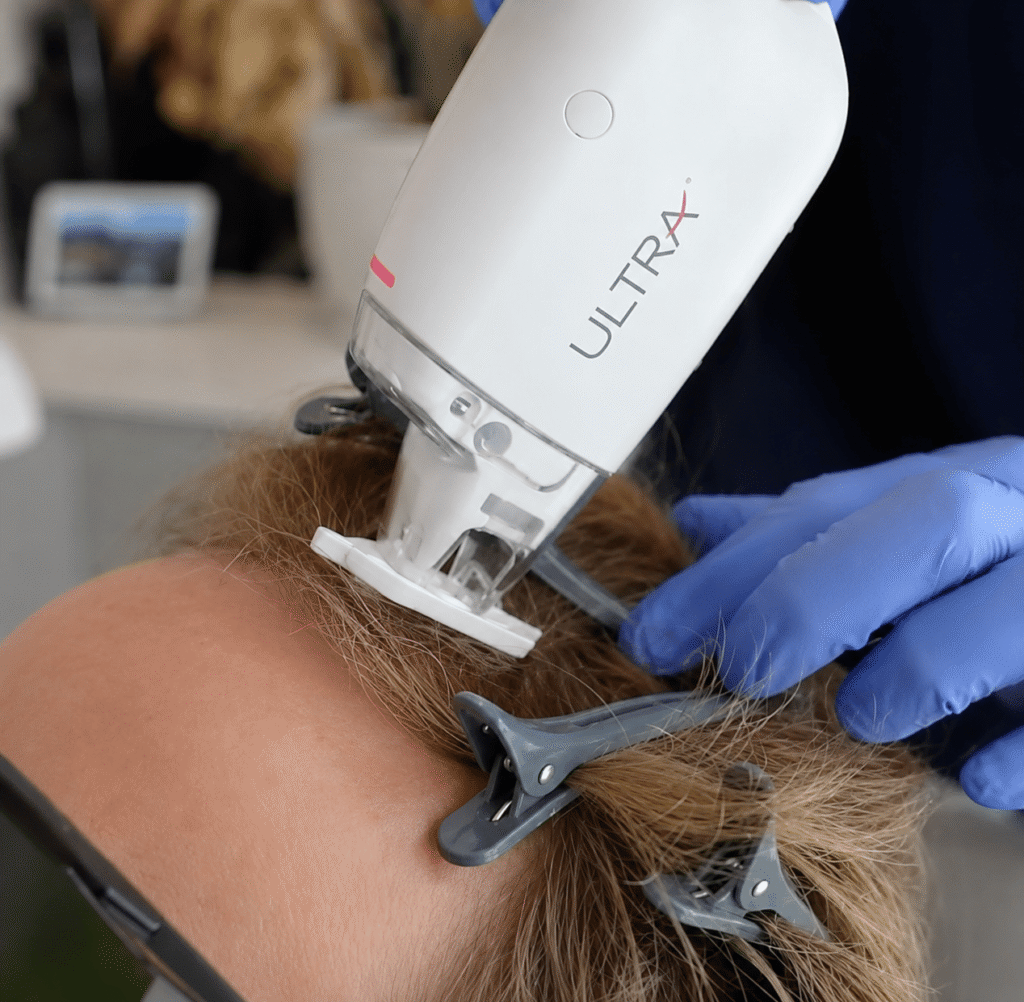
Early thinning, crown thinning, and scalp health each respond best when the underlying cause is identified before treatment. Not every case of thinning has the same driver, and treating the symptom without checking the scalp first often wastes time you didn’t need to lose. Hair restoration for early thinning is the practice of identifying which follicles are still active before choosing a treatment, rather than applying a generic fix to whatever thinning pattern is visible. This guide explains what to evaluate and how exosome scalp treatment fits into a hair restoration plan.
Key Takeaways
- A healthy scalp sheds about 50 to 100 hairs per day, so early thinning is best judged as a change from your own baseline rather than a single daily count.
- Crown thinning often becomes noticeable only after roughly 50% of hair density is lost in that area, which is why early scalp assessment matters.
- Exosome scalp treatment is typically delivered in a series of 3 to 6 sessions spaced about 4 to 6 weeks apart, with results assessed over 3 to 6 months.
How to recognize early thinning before it becomes visible hair loss
The difference between normal shedding and early thinning isn’t about counting hairs in the shower. It’s about pattern change. A healthy scalp sheds about 50 to 100 hairs per day; early thinning is usually a change from a person’s baseline rather than a single daily count. What actually signals early thinning is a wider part, a hairline that’s drifted, or density that looks visibly different in photos taken months apart. Early thinning tends to respond better to treatment because the follicles involved are still active rather than miniaturized down to a nonfunctional state. Once a follicle has fully miniaturized, options narrow.
A proper early assessment covers:
- Visual density mapping
- A pull test to check how easily hair releases from the follicle
- Scalp imaging to look at what’s happening below the surface
- A health history review, since thinning can be triggered by thyroid issues, iron deficiency, stress, or medication changes
In Frisco, Texas, this kind of assessment is where a hair restoration plan should actually start, not where it ends up after a few other things have already failed.
Why crown thinning goes unnoticed until density loss is severe
Crown thinning gets caught late for a simple reason: you can’t see the top of your own head without a mirror trick or someone else pointing it out. Crown thinning can become visible only after roughly 50% of hair density is lost in the area, which is a significant amount of ground to make up by the time most people notice. That’s why relying on “I’ll deal with it when I see it” doesn’t serve you well here.
Crown thinning also behaves differently than hairline recession. Hairline loss tends to follow a visible, gradual retreat that people track in the mirror daily. Crown thinning progresses more diffusely and is often symmetrical, which makes it harder to self-diagnose without imaging or a trained eye. Before treating crown thinning specifically, it’s worth ruling out scalp inflammation, checking how far follicle miniaturization has already progressed, and screening for hormonal drivers like elevated DHT sensitivity, since these change what treatment approach actually makes sense and how quickly you should expect to see a response.
Why scalp condition determines how well hair restoration treatment works
Scalp condition is the foundation, not an afterthought. Buildup from styling products, chronic inflammation, and poor circulation in the scalp can all blunt how well a follicle responds to treatment, no matter how good the treatment itself is. Scalp inflammation from conditions like seborrheic dermatitis can reduce the effectiveness of topical and injectable hair restoration treatments. An inflamed or congested scalp is a worse environment for any restoration approach to work in.
Preparing the scalp before treatment generally means cleansing thoroughly, addressing any active dandruff or seborrheic dermatitis, and calming irritation so the scalp isn’t fighting itself during treatment. Because the recommended timing for stopping topical minoxidil can vary depending on the specific scalp treatment, clients should follow the pre-treatment instructions given by their provider. A real scalp assessment should look at redness, flaking, oiliness, follicle health under magnification, and how much product buildup is sitting on the scalp. Skipping this step and going straight to treatment is a common reason results underwhelm.
How exosome scalp treatment differs from PRP and what the session process involves
Exosomes and PRP get lumped together often, but they’re not the same mechanism. Exosomes carry signaling molecules released from stem cells that instruct surrounding tissue on repair and growth; PRP concentrates growth factors already present in a person’s own blood. Both aim at follicle health, but the biological messaging is different.
Exosome scalp treatment is typically delivered in a series of 3 to 6 sessions spaced about 4 to 6 weeks apart, with results assessed over 3 to 6 months. Delivery is usually through microneedling or injection directly into the treatment area, and most people describe the sensation as mild pressure or a light sting rather than significant pain. Hair restoration treatments at Frisco Body Contouring start at $1,500, with pricing varying based on the treatment plan and individual needs. Afterward, expect some mild redness at the treatment site for a day or two, but there’s no significant downtime. Results build gradually as follicles respond over months, not days, which is why the spacing between sessions matters as much as the treatment itself. At Frisco Body Contouring, exosome scalp treatment sits within a broader plan that starts with the assessment covered above, not as a standalone fix applied without context.
Frequently asked questions
How long does it take to see results from exosome scalp treatment for thinning hair?
Most people don’t see meaningful change after just one session. Since exosome protocols run 3 to 6 sessions over several months, visible improvement in density typically shows up around the 3 to 6 month mark as follicles respond to repeated signaling over time.
Is exosome scalp treatment for scalp care painful?
It’s generally described as mild discomfort rather than pain, whether delivered by microneedling or injection. Most people tolerate it well without numbing, though a topical numbing agent can be used beforehand if someone has a lower pain threshold or a larger treatment area.
Can hair restoration be combined with weight loss treatments?
Yes, there’s no inherent conflict between scalp treatment and body contouring or weight loss work, since they target different tissue systems. Hair restoration and body contouring treatments can often be built into the same overall wellness plan, with scheduling based on the specific treatments involved and the provider’s recommendations, allowing for appropriate spacing when needed to support recovery and optimal results.
How do I know if my thinning qualifies for non-surgical hair restoration?
The best indicator is follicle activity, not how long you’ve noticed thinning. If follicles are still active rather than fully miniaturized, non-surgical options like exosome treatment have something to work with. A scalp assessment with imaging is the only reliable way to know where you stand.
What should I avoid after an exosome scalp treatment session?
Avoid harsh shampoos, excessive heat styling, and direct sun exposure on the scalp for the first few days. Skip strenuous exercise that causes heavy sweating on the day of treatment, since sweat and product buildup on a freshly treated scalp can increase irritation.
What to check before you start a hair restoration plan
Before beginning hair restoration, it’s important to look beyond the scalp and consider factors that may contribute to hair thinning. At Frisco Body Contouring & Ageless Wellness, we assess hormone levels, nutritional status, and overall wellness to better understand each client’s individual needs and develop a targeted hair restoration plan.
