Key Takeaways
- Your baseline body composition and metabolic health determine how well any treatment can reshape fat and muscle, which is why being near your ideal weight before starting improves both the quality of results and complication rates.
- Non-invasive methods like radiofrequency and muscle-stimulation devices work through fundamentally different mechanisms; one tightens skin by heating collagen while the other contracts muscle fibers. Choosing between them depends on whether your concern is loose skin or stubborn fat deposits.
- Body contouring enhances shape and definition in areas where diet and exercise plateau; it does not replace weight loss. Expecting it to function as a substitute leads to disappointment with outcomes that were never realistic. Body contouring targets fat reduction and enhances muscle definition in specific areas through non-invasive or minimally invasive procedures. Many people assume any FDA-cleared machine will deliver the same result, regardless of the individual’s condition when they start. That assumption often leads to wasted money and months of frustration. Your health factors, metabolism, body composition, skin elasticity, and hydration status determine how much change any treatment can produce. The device is just one variable in a multi-variable equation. Ignoring the other inputs guarantees you won’t achieve the desired outcome.
Why your starting health determines how much change any device can produce
Your body’s starting condition sets the ceiling for what any contouring treatment can achieve. Cleveland Clinic notes that being at your ideal weight improves results and lowers complication rates because the treatment is refining shape rather than fighting systemic fat storage. If your metabolism is in a calorie-surplus state or your body composition is mostly visceral fat, non-invasive devices struggle to produce visible change. They are designed to sculpt localized areas, not reverse metabolic dysfunction. Skin elasticity is just as important as fat distribution. Someone with good collagen density and hydration will see tighter, more defined contours after radiofrequency or ultrasound treatment. In contrast, someone with thin, dehydrated skin or significant collagen loss from aging or sun damage will see less dramatic tightening because the tissue cannot contract as much in response to thermal stimulus.
This is not a failure of the device; it reflects the tissue’s physical capabilities. Hydration status, hormone balance, and stress levels affect how your body responds to muscle-stimulation treatments. Cortisol drives fat storage in the midsection and weakens muscle-building signals. Someone under chronic stress will see slower muscle development from electromagnetic stimulation than someone with balanced cortisol. Dehydration reduces the conductivity of the electromagnetic field, meaning the muscle fibers do not contract as forcefully during the session. These factors separate a result that looks like a before-and-after photo from one that seems like a waste of four sessions.
How to match treatment mechanism to your actual tissue concern
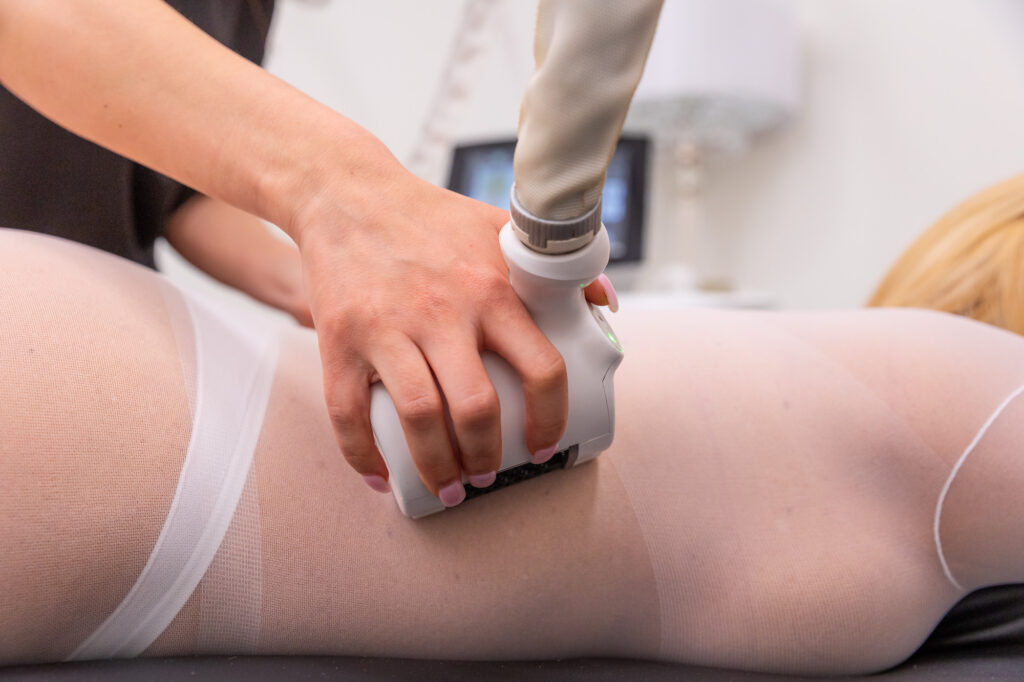
Not all non-invasive treatments target the same tissue layer or use the same mechanism, so choosing one depends on what your body actually needs. Radiofrequency devices heat the dermis to trigger collagen remodeling and skin tightening. They work well when loose skin is the primary concern and fat volume is already low. Muscle-stimulation devices like electromagnetic systems contract muscle fibers to build tone and reduce overlying fat through increased metabolic demand; they are effective when the problem is lack of definition rather than excess volume. Cryolipolysis freezes fat cells to trigger apoptosis; it works when you have pinchable subcutaneous fat in a localized area but do not need skin tightening. Devices that build muscle require multiple sessions to accumulate enough stimulation for visible hypertrophy, but they also improve strength and posture as a side effect. Devices that target fat directly produce faster visible reduction in circumference but do nothing for muscle tone, so you may end up smaller but still soft. Radiofrequency tightens skin without adding volume, ideal for someone who has already lost weight and needs the skin to catch up, but it won’t address fat pockets or muscle atrophy.
| Treatment type | Primary mechanism | Best for | Not ideal when |
|---|---|---|---|
| Radiofrequency | Collagen remodeling via heat | Loose skin, mild laxity | Significant fat deposits remain |
| Electromagnetic stimulation | Forced muscle contractions | Building tone, reducing localized fat | Skin laxity is the main issue |
| Cryolipolysis | Fat cell apoptosis via cold | Pinchable subcutaneous fat | Skin tightening is needed |
Combining treatments addresses multiple tissue layers at once, but it also multiplies cost and time commitment. A realistic assessment of what your body actually needs, fat reduction, muscle building, or skin tightening, prevents you from paying for a mechanism that does not match your starting condition.
What body contouring actually accomplishes versus what it cannot replace
Body contouring is not weight loss. It is shape refinement in areas where diet and exercise have already brought you close to your goal but specific deposits or contours remain stubborn. Expecting a non-invasive device to replace 20 pounds of fat loss is a category error; the treatment cannot and will not do that because its mechanism is localized tissue remodeling, not systemic metabolic change. Cleveland Clinic makes this clear: body contouring helps eliminate fat and shape areas when diet and exercise are not working, meaning it is the final step after the foundational work is done. The realistic outcome is a 10-20% reduction in fat thickness in the treated area over several sessions or a 15-20% increase in muscle thickness with electromagnetic stimulation. That translates to a few centimeters off your waist or more visible abdominal definition, not a total body transformation. If you start from a higher body fat percentage or expect the treatment to handle what a calorie deficit should do, the result will feel disappointing even when the device performed exactly as designed. Skin tightening from radiofrequency or ultrasound improves mild to moderate laxity, not severe sagging. If you have lost 50 pounds and have significant loose skin, a non-invasive device will tighten it but will not eliminate it entirely. Surgical body contouring removes excess tissue; non-invasive methods stimulate the tissue you have to contract. Understanding that distinction prevents frustration when the result is improvement rather than perfection. The most common mistake is treating body contouring as a shortcut. It is not. It is a tool for addressing specific localized concerns after you have done the work to improve your body composition and health markers. Frisco Body Contouring structures treatment plans around this reality, combining advanced non-invasive devices with wellness support to ensure the body is in a state where the technology can deliver results.
What to verify before committing to any treatment protocol
Before committing to any treatment, ask what specific tissue layer the device targets and whether that matches your actual concern. If your problem is loose skin but the provider recommends a fat-reduction treatment, the mechanism does not align with the goal. Ask what the expected reduction or improvement is in measurable terms, centimeters, percentage of fat thickness, or muscle thickness increase, not vague promises about “sculpting” or “toning.” Find out how many sessions the treatment requires and the timeline for visible results. Non-invasive body contouring is cumulative; most protocols require 4-6 sessions spaced a week or two apart, with full results appearing 8-12 weeks after the final session as the body metabolizes destroyed fat cells or builds new muscle tissue. A provider promising immediate results is either overselling or using a different definition of “results.” Ask what happens if you do not see the expected outcome. A legitimate provider will have a plan for reassessing your body composition, adjusting the treatment protocol, or determining whether a different modality is more appropriate. If the answer is “that never happens” or an immediate upsell to additional sessions, you are not getting an honest assessment of how the technology works. Confirm whether the treatment plan includes any wellness or lifestyle component. Body contouring works best when your metabolism, hydration, and stress levels support tissue remodeling.
A provider who hands you a device protocol without addressing those factors is treating the symptom rather than optimizing the system. Finally, ask whether your current body composition makes you a good candidate. If you are significantly above your ideal weight or have uncontrolled metabolic conditions, non-invasive body contouring may not produce the result you want until those baseline factors are addressed. A provider who takes everyone regardless of starting condition prioritizes revenue over realistic outcomes.
Frequently asked questions
How much does a full body contouring treatment series typically cost?
Non-invasive body contouring typically costs between $1,500 and $4,000 for a full treatment series, depending on the number of areas treated and the specific technology used. Electromagnetic muscle-stimulation treatments and combination devices that address both fat and muscle tend to fall at the higher end of that range. Most providers offer package pricing for multiple sessions since a single session rarely produces the cumulative result most clients want.
When will I see visible changes after starting treatment?
Visible results begin to appear 4-6 weeks after the first session, with full results developing 8-12 weeks after the final treatment. This delay reflects the biological timeline for fat cell apoptosis and muscle fiber hypertrophy; your body needs time to metabolize destroyed fat cells and build new muscle tissue. Treatments targeting skin tightening through collagen remodeling follow a similar timeline, as collagen synthesis and remodeling occur over weeks, not days.
What are the common side effects of non-invasive body contouring?
Non-invasive body contouring carries minimal risk when performed correctly. Common side effects include temporary redness, swelling, or soreness in the treated area, which typically resolve within a few days. Rare complications include paradoxical fat hyperplasia with cryolipolysis or burns from improperly calibrated radiofrequency devices. Choosing a provider who uses FDA-cleared devices and has experience with the specific technology significantly reduces these risks.
What should I do if my results fall short of expectations?
First, confirm that enough time has passed for the biological process to complete; many clients assess results too early and miss the full outcome. If 12 weeks post-treatment have passed and the result is still below expectation, schedule a follow-up assessment to review your body composition, treatment protocol, and any lifestyle factors that may interfere with tissue remodeling. In some cases, additional sessions or a different treatment modality may be appropriate.
When is body contouring not the right choice?
Body contouring is not appropriate if you are significantly above your ideal weight, have uncontrolled metabolic conditions like diabetes, are pregnant or breastfeeding, or have active infections or skin conditions in the treatment area. It is also not the right choice if you are looking for weight loss rather than shape refinement. Surgical body contouring is more effective for severe skin laxity or large volumes of excess tissue.
Making the call on your treatment path
The first step is an honest assessment of your body composition and the specific change you want to achieve. If you are still working on foundational fat loss or metabolic health, body contouring will not shortcut that process. If you are near your goal and dealing with localized deposits or contours that are not responding to diet and exercise, then a targeted treatment protocol makes sense. If you are navigating the decision between non-invasive options or trying to determine whether your body composition makes you a good candidate, Frisco Body Contouring offers Styku body scanning and personalized treatment planning that matches the technology to what your body actually needs rather than defaulting to a one-size protocol.
